CHO Cell Culture Media

Chinese Hamster Ovary (CHO) cells are the preferred bioproduction platform for monoclonal antibody manufacturing, owing to advantages such as low human viral transmission risk, human-like post-translational modification, scalability in serum-free systems, and minimal endogenous protein expression. For fed-batch and perfusion processes, JSBio could provide CHO media formulations tailored to address diverse cell clone requirements. JSBio’s CHO media are chemically defined, animal-component-free, cGMP-manufactured, and engineered for high-density cell growth with enhanced recombinant protein expression.

Our Features

Our Strengths

Product Catalog

Product Catalog No. Form Package Size Description User Guide Inquiry and Trial
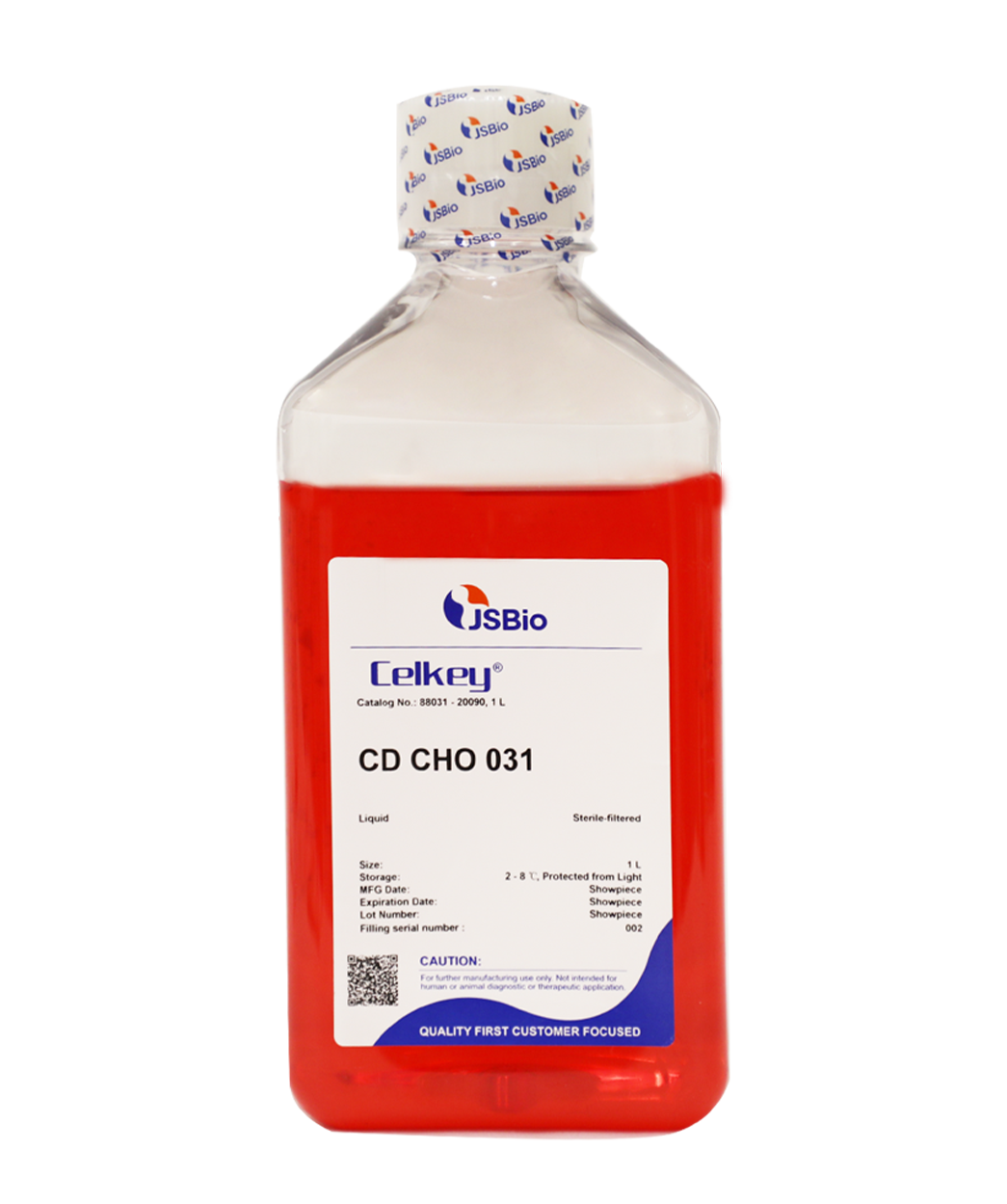
CD CHO 031 88031-585、88031-20090 Dry Powder、Liquid 500 mL, 1000 mL 2 L, 10 L, 50 L, 100 L, Customized Basal medium, for CHO-S, DG44, CHO-K1, CHOZN cells Download
CD CHO 041 88041-1330、88041-23011 Dry Powder、Liquid 500 mL, 1000 mL 2 L, 10 L, 50 L, 100 L, Customized Basal medium, for CHO cells adapted to Dynamis media Download
CD CHO 043 88043-1332、88043-23013 Dry Powder、Liquid 500 mL, 1000 mL 2 L, 10 L, 50 L, 100 L, Customized Basal medium, for fed-batch (CHO-K1) and electroporation (CHO-S/CHO-K1) Download
CD CHO 045 88045-1633、88045-23053 Dry Powder、Liquid 500 mL, 1000 mL 2 L, 10 L, 50 L, 100 L, Customized Basal medium, for CHO-K1Q, CHOZN, and other cells Download
CD CHO 047 88047-1694、88047-24036 Dry Powder、Liquid 500 mL, 1000 mL 2 L, 10 L, 50 L, 100 L, Customized Basal medium, for fed-batch culture of LONZA, CHO-DG44, CHO-DXB11, CHO-S Download
ALLY CHO 100a 99169-1512 Dry Powder 2 L, 10 L, 50 L, 100 L, Customized Feed medium, requires ALLY CHO 100b and basal medium Download
ALLY CHO 100b 99169-1473 Dry Powder 2 L, 10 L, 50 L, 100 L, Customized Feed medium, requires ALLY CHO 100a and basal medium Download
CD Feed 018 99155-1333 Dry Powder 2 L, 10 L, 50 L, 100 L, Customized Feed media a, for fed-batch (compatible with CD CHO 041/043/045/047 and CD Feed 017) Download
CD Feed 017 99035-1250 Dry Powder 2 L, 10 L, 50 L, 100 L, Customized Feed media b, for fed-batch (compatible with CD CHO 041/043/045/047 and CD Feed 017) Download
APEX CHO 100 88100-1497 Dry Powder 2 L, 10 L, 50 L, 100 L, Customized Basal/feed medium for perfusion processes Download

Frequently Asked Questio

Q:如何提高单克隆抗体的产量?
A:对于特定的单克隆,一般通过提高细胞密度,延长平台期,提高Qp。
Q:公司对化学成分界定培养基的定义是什么?
A:健顺生物的化学成分界定培养基是指培养基中没有任何无法定义的组分,如血浆提取物、植物水解物等。所有组分的都是可以被定义的且浓度明确,也可以包含重组蛋白。

Case Studies

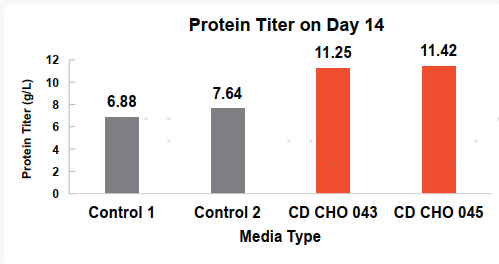
Protein Titer Related Cases: Case 1

Figure 1. Comparison of protein yields on Day 14 across different projects using JSBio's basal media CD CHO 043, CD CHO 045, and control media.

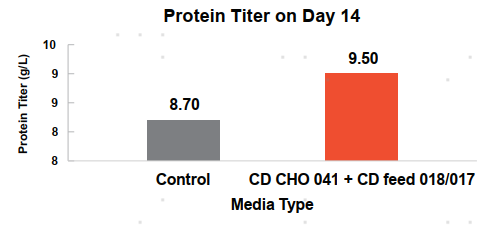
Protein Titer Related Cases: Case 2

Figure 2. Comparison of protein yields on Day 14 using JSBio's medium CD CHO 041 (basal medium) supplemented with CD Feed 018/017 (feed media) versus an imported commercial medium (control group).

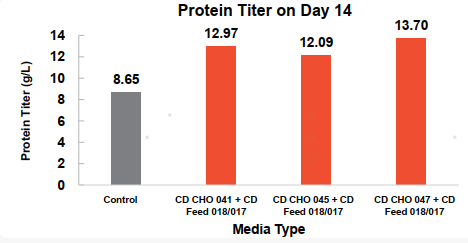
Protein Titer Related Cases: Case 3

Figure 3. Comparison of protein yields on Day 14 using JSBio's commercial basal media supplemented with feed media versus an imported commercial medium (control group).

Cell Growth Related Cases

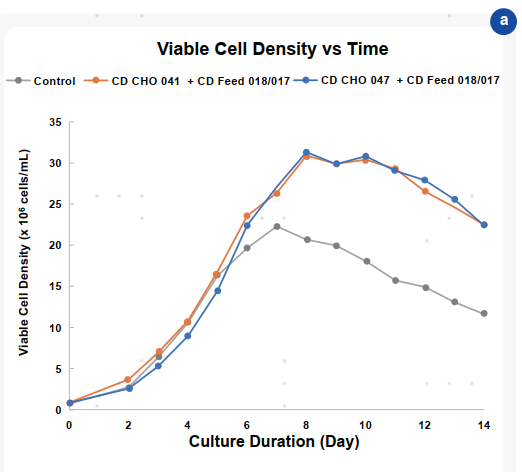
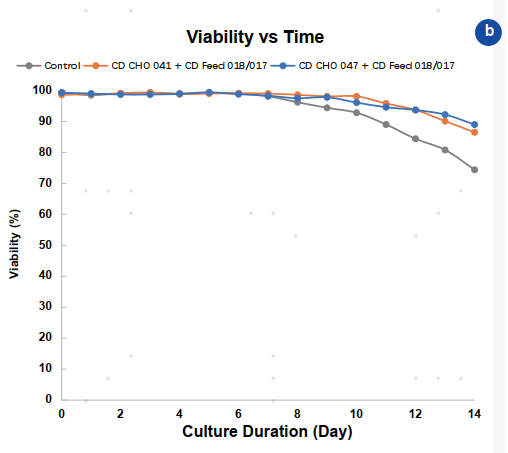
Figure 4. Comparative analysis of JSBio's commercial basal medium combined with fed-batch media versus an imported commercial medium (control group) over a 14-day cultivation period a) VCD; b) VIA

Analytical Characterization Tests

Table 1. Analytical characterization comparison between CD CHO 041 + CD feed 018/017 media with focus on SEC, CE-NR, and CEX

Table 2. Performance comparison between CD CHO 031 + ALLY CHO 100a/100b media on Day14, including VIA, Titer, and Qp

Perfusion Process Cases

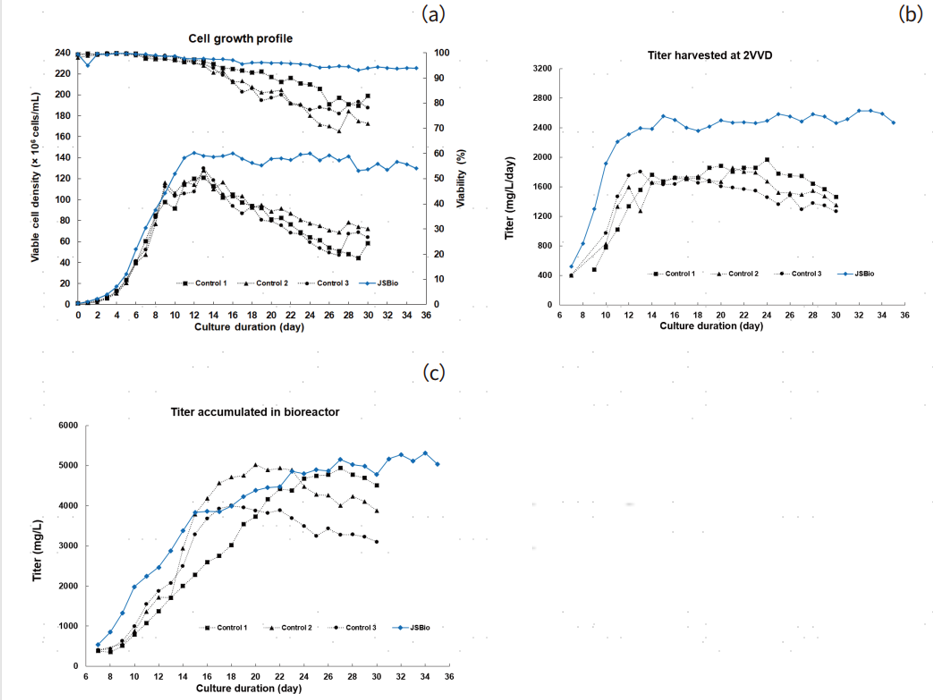
APEX CHO 100 perfusion culture medium is capable of sustaining high cell density and viability over an extended period, leading to elevated antibody production at approximately 2.5 g/L/day. Additionally, this culture medium aids in reducing product accumulation in the reactor and enhances process operability.

Figure 5. Preparation of monoclonal antibodies using different culture media through perfusion process, VVD=2. (a) The growth curve of cells. (b) The daily production of antibodies harvested outside the reactor. (c) Accumulated antibody production in the reactor