​Insect Cell Culture Media

Insect cells (e.g., Sf9, Sf21, H5) are widely adopted for recombinant protein production due to their post-translational modification capability, high expression yields, scalability, and safety for vertebrate applications. JSBio's insect cell culture media are manufactured under GMP conditions, formulated as serum-free, animal component-free media that support high-density cell growth and enhanced recombinant protein expression.
Our Features

Our Strengths

Product Catalog

Product Catalog No. Form Package Size Description User Guide Inquiry and Trial
IT SFM 03 11009 - 1353、11009 - 23027 Dry Powder、Liquid 500 mL, 1000 mL, 2 L, 10 L, 50 L, 100 L, Customized Serum-Free Medium Download
Insect SFM 1407 11003-1407 Dry Powder 2 L, 10 L, 50 L, 100 L, Customized Serum-Free Medium Download

Frequently Asked Questio

Q:昆虫细胞可以在37℃培养么?
A:不可以。长期暴露于29°C以上的温度会导致细胞死亡。这些细胞最好生长于27°C或室温条件下。
Q:Sf9、Sf21、H5细胞的区别是什么?
A:

细胞 来源 用途
Sf9 从草地贪夜蛾蛹(Spodoptera frugiperda)的卵巢组织所得细胞系IPLB-SF21-AE分离得到的克隆 适于转染、生产高滴度病毒以及表达重组蛋白,使用最广泛
Sf21 从草地贪夜蛾蛹(Spodoptera frugiperda)的卵巢组织所得细胞系IPLB-SF21-AE衍生所得的克隆 适于转染、生产高滴度病毒以及表达重组蛋白。Sf21细胞可能比Sf9细胞表达蛋白量更高。
H5 来源于粉纹夜蛾(Trichoplusia ni)的成熟卵巢组织 转染效率偏低,不建议作为bacmid的转染细胞系;但是一旦得到重组病毒,HighFive细胞表达重组病毒性能优越,更适合表达分泌型重组蛋白

Q:细胞悬浮培养过程中活率低于90%如何处理?
A:

昆虫细胞在悬浮培养过程中活率低于90%,可排查以下原因:
1. 叶轮旋转剪切力的影响。可加入Pluronic F-68,使得终浓度达到所需0.1%。
2. 通风不良。①培养液体积不宜超过摇瓶容积的1/2; ②培养基体积接近最小要求体积;③叶轮旋转流畅。急动颠簸则通风不良。
3. 杆状病毒或真菌污染。①换掉旧培养基然后使用新鲜培养基。②培养基加抗生素。
4. 野毒或重组杆状病毒污染。可见细胞裂解、碎片和/或细胞鼓胀。核内容物表明野生型感染。①换掉旧培养基然后使用新鲜培养基。②在能触及杆状病毒的地方要求使用完全无菌的摇瓶。

Case Studies

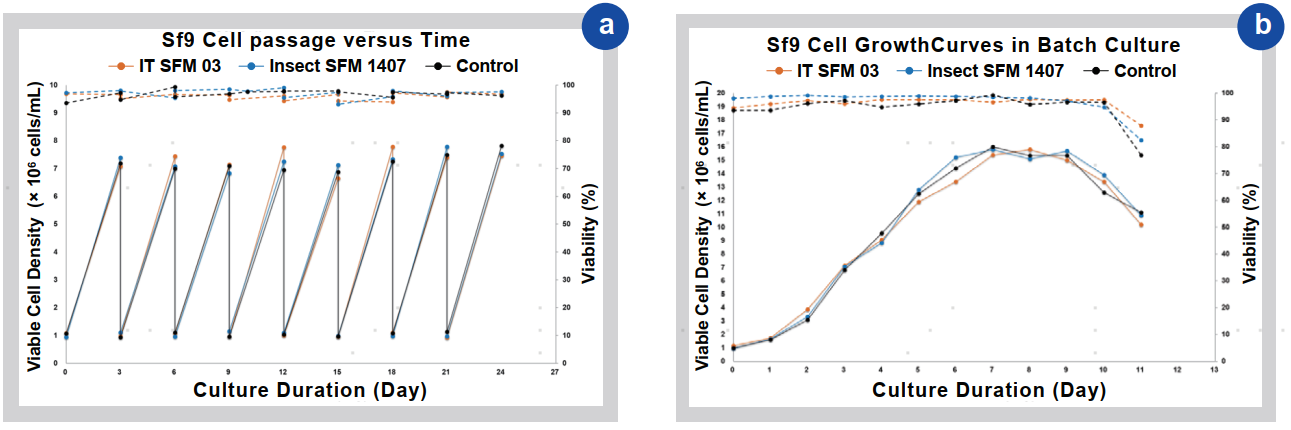
Growth of Sf9 Cells

Figure 1.
a) Passage culture of Sf9 cells using JSBio media and control medium, seeded at 1.0 × 10⁶ cells/mL; the cell density reaches 7.0–8.0 × 10⁶ cells/mL after 72 h.
b) Batch culture of Sf9 cells using JSBio media and control medium, seeded at 1.0 × 10⁶ cells/mL; the peak viable cell density reaches 15.0–16.0 × 10⁶ cells/mL.

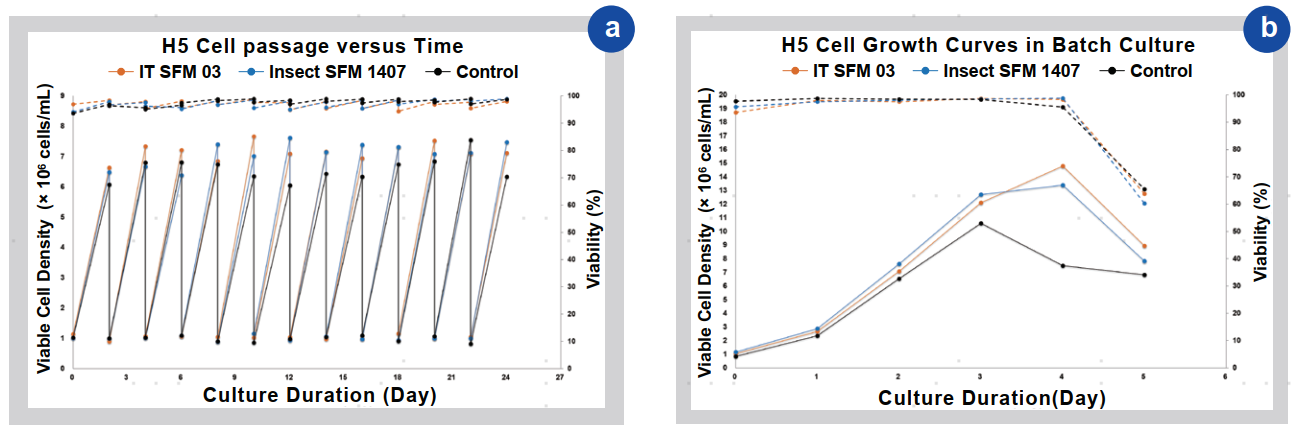
Growth of H5 Cells

Figure 2.
a) Passage culture of H5 cells using JSBio media and control medium, seeded at 1.0 × 10⁶cells/mL; the cell density reaches 6.0–7.0 × 10⁶cells/mL after 48 h.
b) Batch culture of H5 cells using JSBio media and control medium, seeded at 1.0 × 10⁶ cells/mL; the peak viable cell density reaches 13.0–15.0 × 10⁶cells/mL.

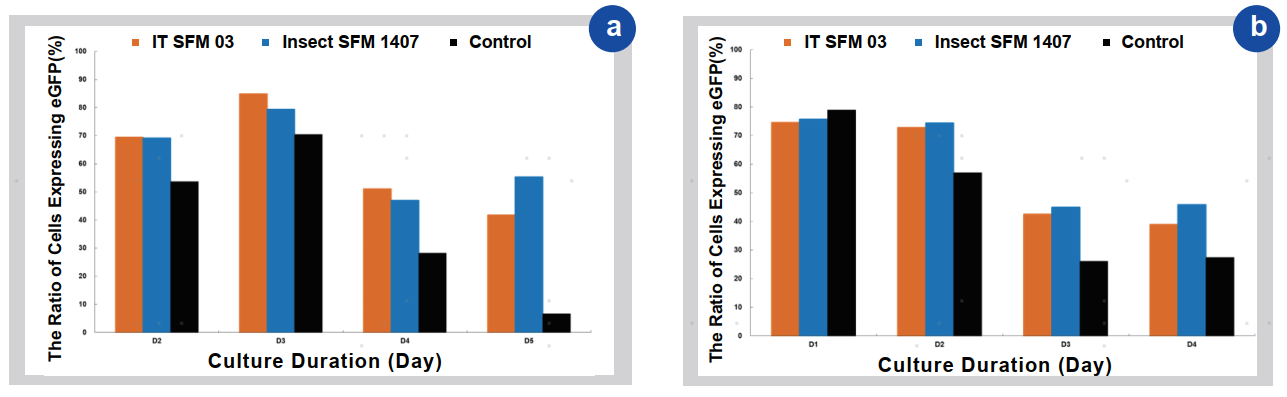
Insect cell culture media series enable higher infection efficiency

Figure 3.
a) Infection of Sf9 cells with viral seeds in different media; the proportion of eGFP-expressing cells was detected after infection, showing an advantage over competitor media.
b) Infection of H5 cells with viral seeds in different media; the proportion of eGFP-expressing cells was detected after infection, showing an advantage over competitor media.

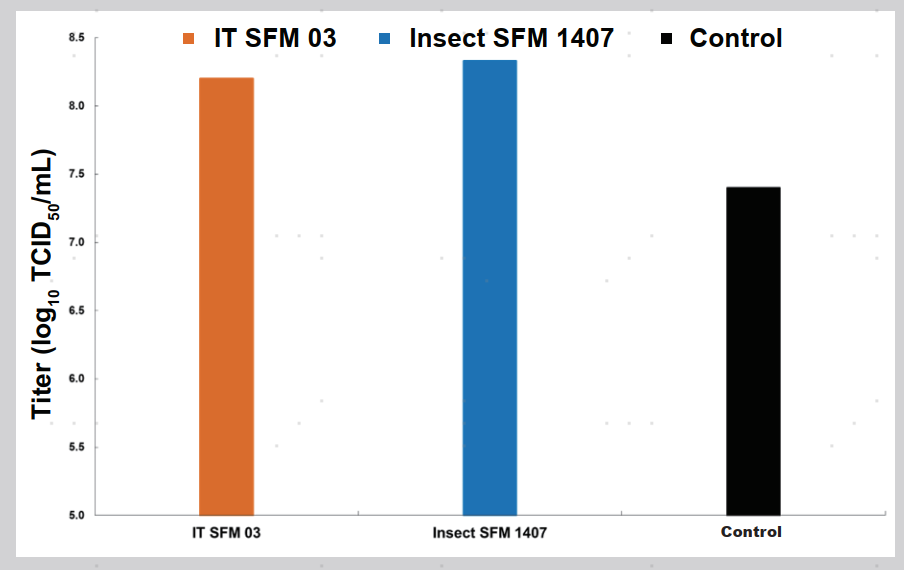
Higher viral seed titers

Figure 4. Superior viral seed titers in Sf9 cells cultured with JSBio’s media compared to that of competitor media

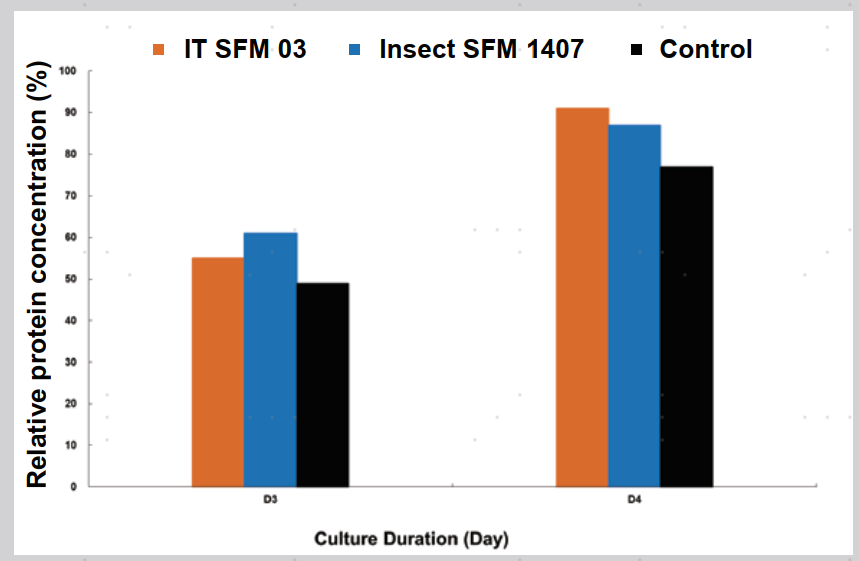
Higher recombinant protein expression.

Figure 5. Superior protein expression level of classical swine fever E2 in H5 cells cultured with JSBio’s media compared to that of competitor media